
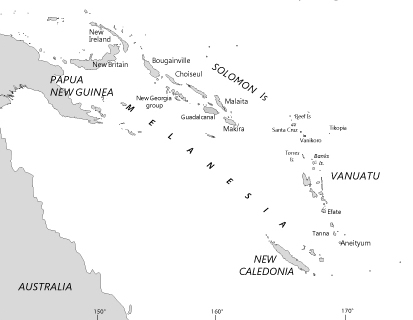
(Click on the map to enlarge it)
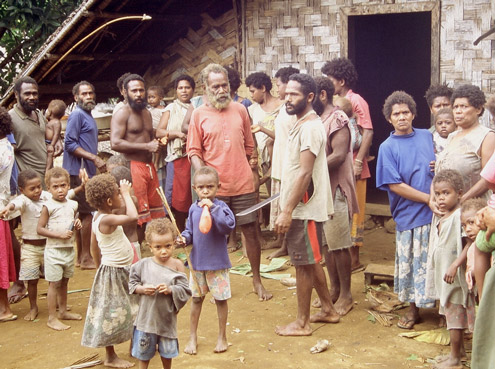
The area traditionally identified as Melanesia, in the southwestern Pacific, includes New Guinea, the Solomons, Vanuatu, New Caledonia and Fiji. This region shows an extreme cultural and linguistic diversity, with several hundreds of languages.
Some of these languages belong to the Austronesian family; as for the non-Austronesian languages of New Guinea and the Solomons, they are known under the cover term of “Papuan” languages.
In the middle of this vast area, the Republic of Vanuatu is home to approximately 106 distinct languages, for a population of 234,000 (2009 census). With only about 2000~2200 speakers per language, this country has the world's highest linguistic density per capita. The sheer number of these languages has two consequences:
- the description and documentation of all these languages will require the joint effort of many linguists, and several decades;
- these languages are spoken by small numbers of speakers: they are thus vulnerable to social changes, which can lead them quickly to situations of linguistic endangerment.
Through my work as a linguist, I hope to take part in this collective endeavour: understand, document and support the Melanesian languages of the Pacific Ocean. My personal contribution to the field takes the form of data collection on the languages spoken in the far northern Vanuatu (Torres & Banks islands), and far eastern Solomons (Vanikoro island, in Temotu province) – see more detail on my Fieldwork page.
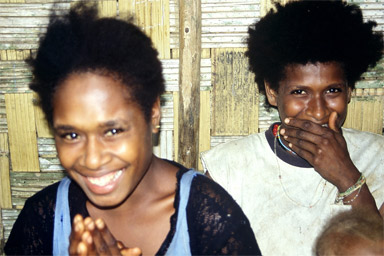
Because these languages are not written and are spoken by small island communities, this means that I have spent a fair part of the last few years in the field. What I do is simply live with the people, share their daily activities, and get them to teach me their various languages. Once back home, I try to make sense of my handwritten notes and publish them, in order to share my findings from the field with the rest of the world's community of linguists. This can take the form of academic papers on specific points of these languages, or complete grammars and dictionaries.
Also, I try to make my research meaningful outside the world of academic linguists. This includes collaborating with non-linguists (anthropologists, archaeologists, ethnomusicologists…); sharing knowledge with a wider audience (e.g. via this website, or via documentaries and interviews); and making my expertise useful to the communities of speakers themselves – e.g. through the creation of booklets to promote vernacular literacy, or to keep the memory of traditional oral stories.

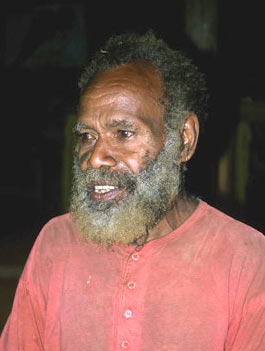
On this site, you will find some maps of the relevant archipelagoes, and see the detail of the individual languages on which I have done fieldwork. You can browse my fieldwork photos or videos, and access my audio archives. From my publications page, you can download my thesis, or my research papers. You may want to browse my online dictionary of Mwotlap (Banks Is, Vanuatu), or of Teanu (Vanikoro, Solomon Is.).
You can have a glimpse of traditional stories from the region, presented here in trilingual format – unless you prefer to discover the traditional music of Vanuatu by listening to our CD album.
If you can read French (icon  in menus), you can also travel to Motalava, a small island of northern Vanuatu, and become familiar with the culture and language of the Motalava people. Or you can learn about the fate of the French navigator Lapérouse, who disappeared on the island of Vanikoro, one day of 1788.
Finally, you can find more links to other great websites to pursue your explorations further.
Enjoy your visit!
 I am based in Paris, in the research center LaTTiCe (Langues, Textes, Traitements informatiques, Cognition), linked with École Normale Supérieure, University Paris Sorbonne nouvelle, and CNRS (French National Center for Scientific Research), where my position is Directeur de recherche (Senior Research Fellow).
→ See my profile on the LaTTiCe homepage.
 During the period 2009–2012, I was also a Visiting Fellow in the Linguistics dept of the School of Culture, History and Language, at the Australian National University (A.N.U.), in Canberra. Since my return to France, I've become a Honorary Associate Professor there.
→ See my profile on the ANU homepage.
In the last few years, I have been leading a few scientific projects:
-
2004–2007:
 Music of Vanuatu — About the musical arts of Vanuatu societies.
-
2008—:
Colexification studies — Towards a typology of lexical structures.
-
2011—:
Historical Glottometry — A non-cladistic approach to language genealogy.
-
2022–2025:
ComPLETE — “Complex Predicates in Languages: Emergence, Typology, Evolution”.
-
2023—:
𝓔𝓿𝓸Sem — “A database of dialexification across language families”.
-
2024—:
𝓔𝓿𝓸Lex — “An online series of comparative dictionaries”.
-
2025—:
HéLiCéO — “Héritages Linguistiques, Cultures orales, Éducation en Océanie”.
You can find more detail on these different projects in the “Marama” section of this homepage – with links to the relevant websites associated with these projects.
You can download my  résumé (CV, 2024).
My email address: < alexandre.francois - at - ens.psl.eu >.
