
 The present website – labelled “marama” – collects various resources relevant to the scientific study of language, starting from the languages of the Pacific, but with relevance for the languages of the world more generally. This section in particular brings together information on some scientific projects of mine, concerning different facets of linguistic systems and their evolution: sound change, morphosyntax, grammatical and lexical semantics, language genealogy and areal diffusion.
The name *marama is borrowed from an ancient language: the Oceanic ancestor of north Vanuatu languages, sometimes called “Proto North Vanuatu”. It means “the World” – and more exactly, “the Visible World as perceived by humans”, contrasting with *banoi “the Invisible World of spirits”. I reconstructed this pair of concepts in my 2013 paper on the spiritual vocabulary of North Vanuatu and its etymologies (see pp.228–229) — and the excerpt shown here).
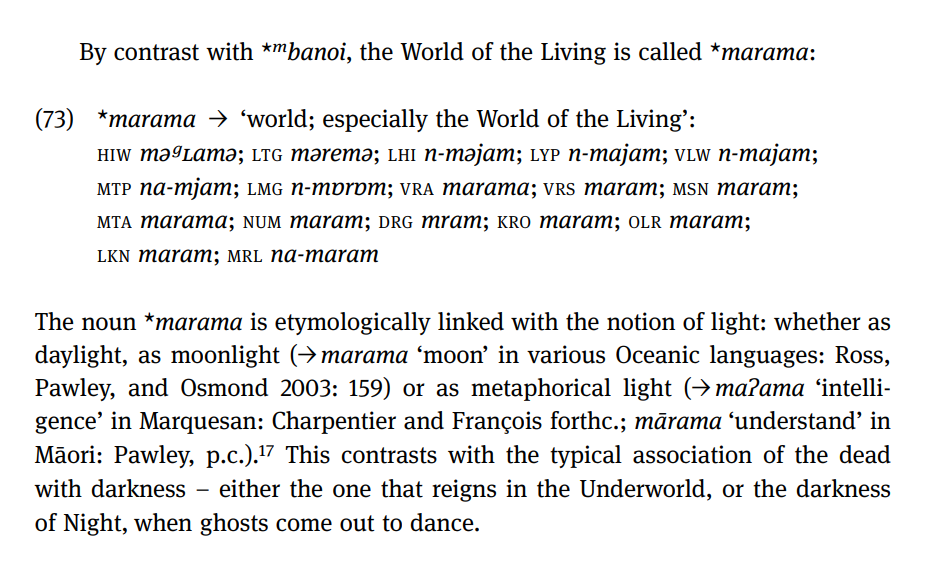 In fact, PNV *marama ‘the (visible) world’ originates in a Proto-Oceanic word *ma‑ramaR ‘shining, bright’ [see its etymograph on 𝓔𝓿𝓸Sem!]; the latter, in turn, has its source in Proto-Austronesian *damaR ‘tree resin used in torches → light’. Isn't this a fascinating semantic path?
{tree resin → torch → light → shining, bright → moonlight, moon → visible world}
but also
{… shining, bright → clear → explain → understand}…
This name marama is thus a tribute to the Oceanic languages and cultures of Vanuatu, which provided the initial inspiration for my reflections; but its meaning also reflects my desire to “understand” the “world” as a whole, in a search for universal features of languages. Finally, my choice of Marama rather than Banoi, is a reminder that my approach is empirical, and rests primarily on the observable reality that can be perceived – even when it proposes theoretical generalisations.
The tabs on this page provide links to a few scientific projects where I've been involved.

