wa wa coordinator
2 – between clausesand; butentre propositionset; mais
| Ne-m̄e mu-wuh yatkel et susu wa yatkel susu valaplag.The seasnake killed some children, but some children managed to escape.Le serpent de mer réussit à tuer plusieurs enfants, mais quelques enfants réussirent à s'enfuir. |
seeba ①
3 – after clause ending in rising intonationwhen suddenlyaprès une proposition à intonation montantelorsque soudain
| Nok yow van so tēy kē wa kē ni-gityak m̄ōl!I jumped to catch him, but he ran off!J'ai bien sauté pour le rattraper, mais il est parti en courant ! |
| Ēkēh! Nok so ha nē-bē wa – nē-bē kē ne-het!Crikey! I wanted to drink this water, but – it's dirty!Aïe ! J'allais boire cette eau, mais – elle est toute sale ! |
derivativeewa
w[a]ha na-wha nawha noun
<°həwá<°sawáePNCV*savwadance
Cf. haw
Les mots des danses nawha ✧ Words of nawha dances ✧ kaka be-wha
| na-tno waha | place de l'orchestre | place of the orchestra |
| ige be-wha | les musiciens nawha | the nawha musicians |
| na-qyēn̄ malbuy | planche à rythmes | stomping board |
| didi ② ⓑ▻② | battre la planche | stomp the board |
| nē-qētdidi | bâtons pour la planche | stomping sticks |
| nē-vētōy | tambour fendu | slit drum |
| lam̄ | jouer le tambour | beat the drum |
| nē-qētlam̄lam̄ | bâtons à tambour | drum sticks |
| avus | leader du groupe | the band leader |
| ige ba-laklak | les danseurs | the dancers |
| hi | jouer ‹musique à danser› | play ‹dancing music› |
| na-mapto | danse namapto | namapto dance |
| no-yon̄yep | danse noyongyep | noyongyep dance |
| na-lan̄vēn | danse nalangven | nalangven dance |
| haw | [♂️] danser le noyongyep | [♂️] dance the noyongyep |
| lōs | [♂️] danser le nawha | [♂️] dance the nawha |
| yes | [♀️] danser le nalangven | [♀️] dance the nalangven |
Dance
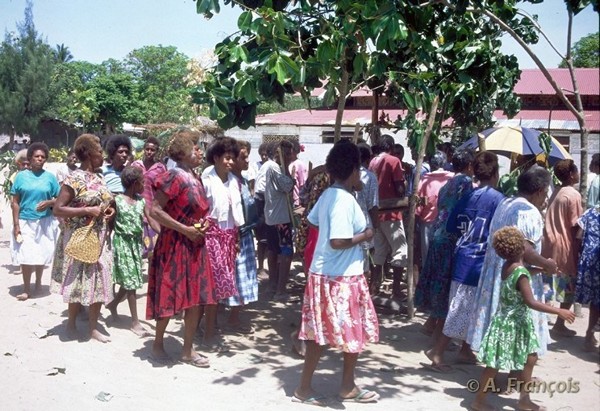
1 – a collective performance during which villagers dance around (lak walēg) the drumming orchestra (ige be-wha), in the middle of the village area (tenepnō)danse collective, lors de laquelle les villageois dansent autour (lak walēg) un groupe de musiciens (ige be-wha), au milieu de la place du village (tenepnō)
| Gēn vay qiyig na-wha, tō gēn van walēg.If you dance the nawha, you go around [the musicians].Si on danse le nawha, on tourne en rond autour [des musiciens]. |
| Na-wha ni-tig a ni-tig meyen.The dances went on and on till dawn.La danse continua, continua jusqu'à l'aube. |
Les danses de village ✧ Village dances ✧ Gēn galeg nawha
Par contraste avec certaines danses sacrées ou réservées aux initiés (→qet ②, m̄e▻③, mag; ⇒ no-kolkol), les danses nawha sont profanes, et donc ouvertes à tous les villageois – hommes ou femmes, jeunes ou vieux. Elles ont toujours lieu sur la place publique du village (na-tnepnō), à l'occasion de mariages (ne-leg) ou de fêtes villageoises (nō-qōn̄ liwo). Les danses publiques les plus connues sont le na-mapto; le no-yon̄yep; et la danse des femmes, le na-lan̄vēn. Leur point commun est de faire tourner les danseurs autour du groupe de musiciens (ige be-wha), dont l'instrument emblématique est la planche à rythmes na-qyēn̄ malbuy.
In contrast to sacred or initiate dances (→qet ②, m̄e▻③, mag; ⇒ no-kolkol), nawha dances are profane, and therefore open to all villagers – men or women, young or old. They always take place on the central area of the village (na-tnepnō), on the occasion of weddings (ne-leg) or village festivals (nō-qōn̄ liwo). The best-known public dances are the na-mapto; the no-yon̄yep; and the female dance na-lan̄vēn. Their common point is to have the dancers revolve around the ensemble of musicians (ige be-wha), whose emblematic instrument is the stomping board na-qyēn̄ malbuy.
Music
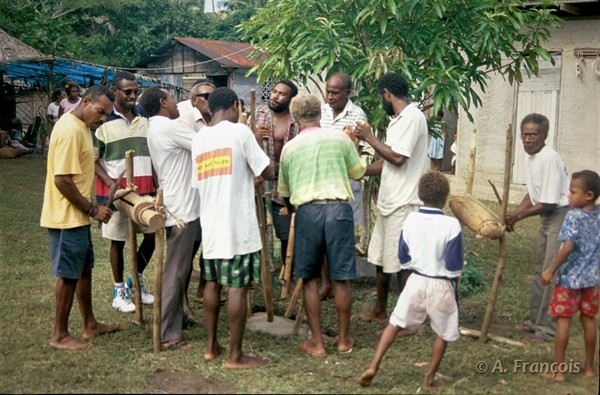
2 – metonmusical ensemble, consisting of slit drums (nē-vētōy) and a stomping board (na-qyēn̄ malbuy), and performing for village dances (w[a]ha▻①)métonformation de percussionnistes, incluant tambours à fente individuels (nē-vētōy) et planche à rythmes (na-qyēn̄ malbuy), jouant pour les danses villageoises (w[a]ha▻①)
| na-tno waha the place for the orchestra (in the middle of the area)l’emplacement des musiciens (au centre de la place) |
| N-eh en, kem galeg na-wha aē le-Krismas e tō kēy yes aē.That song we can turn into dancing music at Christmas, and people come and dance it.Ce chant, nous en faisons une musique de danse à Noël, et les gens viennent danser dessus. |
📙 Si l'ensemble ajoute un tambour à membrane (na-tmatwoh), l'orchestre s'appelle alors na-wha titi.
📘 If the ensemble adds a membrane drum (na-tmatwoh), it is then called na-wha titi.
ige be-wha strong noun
those for nawha musicthe nawha musiciansceux pour le nawhales musiciens du nawha
Les musiciens du nawha ✧ The nawha musicians ✧ ige be-wha
Ige be-wha gēn. Ete tēlge bul tēl tēytēy nē-qēt-lam̄lam̄, kēytēl ta-lam̄ qiyig namuytēl nē-vētōy. Tō yatkelgi mey a nē-tēy nē-qēt-didi en, kēy didi hōw na-qyēn̄ malbuy. Ba yoge en, et tēy te muy hap te en, yoge ba-vavap eh.
“Voici les musiciens du na-wha. Les trois hommes qui tiennent des bâtons de percussion joueront du tambour fendu. Ceux qui tiennent des bâtons à rythme frapperont la planche à percussions. Quant aux deux qui n'ont rien dans les mains, ce sont les deux chanteurs.”
“Here come the na-wha musicians. The three men holding drumming sticks, they will soon be playing their slit drums. Those who're holding long pounding sticks will be striking the stomping board. As for those who're holding nothing, they are the two singers.”
na-tno waha noun
Dance
place of the orchestraplace where the orchestra for na-wha dances is set up for a day, in the middle of the village area (tenepnō)place de l'orchestreendroit où se trouve installé, pour une journée, l'orchestre de musique na-wha, au milieu de la place du village (tenepnō)
| Ige le-lo vōnō e kēy me-hgēl na-tno waha.The villagers have decorated the spot where the orchestra will be.Les villageois ont décoré la place de l'orchestre. |
📙 Autour d'un trou creusé dans le sol (cf. na-qyēn̄ malbuy), s'élèvent des poteaux, auxquels sont fixés les petits tambours fendus (nē-vētōy).
📘 Around a pit dug in the ground (see na-qyēn̄ malbuy), wooden posts are stuck in the ground, to support the individual slit drums (nē-vētōy).
wak wak
MotawakaPOc*(p,pʷ)oga(q)burst open, split open
Atransitive verb
open ‹door+, bottle+›ouvrir ‹porte+, bouteille+›
| Wak na-mteēm̄!Open the door!Ouvre la porte! |
| tēm wakopen by pushing, pressing the doorouvrir en poussant, en enfonçant la porte |
| qēyēt wak[poke open] dial the door code[appuyer du doigt ouvrir] faire le digicode |
| Kē ni-wak na-mtēgtap non mayanag, kē ni-kalō me.He opened the chief's door, and came in.Il ouvrit la porte du chef, et entra. |
antonymtabegfermerclose
waksē waksɪ adjective
vain, proud, self-important (in a good or bad way)vaniteux, orgueilleux, fier de soi (en bonne ou mauvaise part)
| Na-waksē!Show-off!Vantard! |
| Ige vēt-waksē kēy ne-myōs vanvan a le-myōs nono-y mahge-y.Proud people only want to follow their own desires. Les gens fiers ne veulent obéir qu'à leur propre désir. |
w[a]laglē na-wlaglē nawlaɣ̞lɪ noun
Fish
Orangespine unicornfish, bsl. Yeloteil strong sikinNason bariolé, poisson récifalNaso lituratus.
w[a]lak walak
Motawalakato lift, open up
w[a]lawlē na-wlawlē nawlawlɪ noun
Flora
a tree (unidentified), out of which axe handles are being carvedun arbre (non identifié), dont on fait notamment des manches de hâche
walēg walɪɣ̞
wan̄ waŋ transitive verb
PNCV*waŋagape, open the mouthPOc*paŋabe open, gape
gape, open ‹the mouth›ouvrir ‹la bouche›
w[a]tag na-wtag nawtaɣ̞ noun
Flora
edible plant (Lecythidacea), bsl. Naveleplante comestible (Lécythidacées), bsl. NaveleBarringtonia edulis.
seene-vel
w[a]tagbōlga na-wtagbōlga nawtaɣ̞ᵐbʊlɣ̞a noun
Anthropology
nawtagh-bolgha: k.o. ritual of collective dance (see na-mapto, no-yon̄yep) played all night long, uninterrupted, until dawnnawtagh-bolgha: rituel de danse collective (cf. na-mapto, no-yon̄yep) joué toute la nuit, sans interruption, jusqu'à l'aube
📙 Dans le mythe de Vēnvēntey, cette danse frénétique est associée au meurtre du héros.
📘 In the myth of Vēnvēntey, this frenetic dance is associated with the murder of the hero.
wawsē na-wawsē nawawsɪ noun
Fish
Blackspot emperor, reef fish, 42 cmBossu tacheté (angl. Blackspot emperor), poisson récifal, 42 cmLethrinus harak.
w[e]hey wɛhɛj adjective
welan ne-welan nɛwɛlan strong noun
PTB*laⁿdoname of a chiefly rank
Anthropology
1 – king, traditional chief of significant importance; important figure with an honorary title in ancient societyroi, chef traditionnel d'une certaine importance ; personnage important doté d'un titre honorifique dans la société ancienne
📙 A distinguer de mayanag, lequel désigne un maire ou chef élu, dont les pouvoirs se limitent aux affaires courantes du village, et n'impliquent pas, comme le welan, de considération honorifique particulière.
📘 Must be distinguished from mayanag, which refers to an elected mayor or chief whose powers are limited to the village's current affairs and do not involve, like welan, any particular honorary consideration.
2 – henceany person superior in power and honor within a hierarchy; the President of the Republic, the government, the employer, etc.par exttoute personne supérieure en pouvoir et en honneur, dans une hiérarchie ; le président de la République, le gouvernement, l'employeur, etc.
| Ne-welan mino, key et buste.My bosses oppose it. Mes patrons s'y opposent. |
📙 Pour les termes modernes, on aura également des emprunts au bislama : no-bos bos 'patron', ni-kin̄ king 'roi', etc.
📘 For modern terms, there are also borrowings from English, via Bislama: no-bos bos 'boss', ni-kin̄ king 'king', etc.
wele wɛlɛ particle
1 – because; indeed; it's just that... Introduces an explanationregistre formelcar; en effet; c'est que… Introduit une explication
| Nok van veyeh, wele na-lo mal yoy.I must go back without delaying too much, because the sun has already set. Je dois rentrer sans trop tarder, car le soleil s'est déjà couché. |
| Ba wele, na-gvēg nan en, na-qyan̄ nonon aē.And indeed, this apple tree had a hollow trunk. Et en effet, ce pommier avait un tronc creux. |
casual synonymveg
Discourse
2 – espintroduces an unexpected explanation or one that contradicts the context: hence, ‘in fact’, ‘in truth’, ‘in reality it's that…’spécintroduit une explication inattendue ou en contradiction avec le contexte: d'où ‘en fait’, ‘en vérité’, ‘en réalité c'est que…’
| Nok a ten̄ velqōn̄ tō be-mino siok agōh, wele inēk gēn a inēk a leplep bat en!I lamented every day about my canoe, and in fact, it was you who were hiding it! Je me lamentais tous les jours sur ma pirogue, et en fait c'était toi qui la cachais! |
| O ba wele nēk so m̄ōl; togtō en, so igēn tiwag mi kē.Unfortunately [lit. but in fact], you must go back home; otherwise, we would have all left together. Mais malheureusement [litt. mais en fait], tu dois rentrer chez toi; sinon, nous serions partis tous ensemble. |
synonymakē
ba wele wo particle
freqIntroduces, often as a parenthetical, an explanation from the speaker that directly contradicts a belief expressed in the context. Hence, ‘but in fact’, ‘but in reality’courIntroduit, souvent sous forme d'incise, une explication émanant du locuteur, en contradiction directe avec une croyance exprimée dans le contexte. D'où ‘mais en fait’, ‘mais en réalité’
| Kē wo “Tateh, imam, no et-vanvan te hag!” – ba wele wo kē ni-galgal ēwē veg kē mal van hag en.“No, father, I never went to that village!” – in reality, it was a lie, because he had already been there. “Non, mon père, s'écria-t-il, je ne suis jamais allé dans ce village!” – en réalité, c'était un mensonge, car il s'y était déjà rendu. |
| Nēk ma-gal no so nēk mahgē, ba wele wo kōmyō qulqul nōnōm!You lied to me by claiming you were alone: in reality, you were with your girlfriend! Tu m'as menti en prétendant que tu étais tout seul: en réalité, tu étais avec ta petite amie! |
w[e]seg wɛsɛɣ̞
woseg
transitive verb
Redupw[e]sewseg
pulltirer
synonymyap ①
1 – pull ‹s.th., s.o.› toward oneselftirer ‹qqch, qqn› à soi
| weseg kal / tēqēlpull upward / downward tirer vers le haut / vers le bas |
| Kōyō vēy-wesewseg na-gaymayō.They kiss on the mouth [lit. pull each other's tongue] Ils s'embrassent sur la bouche [litt. se tirent la langue l'un l'autre] |
📙 Suggère un effort moindre que son synonyme yap ①.
📘 Suggests less effort than its synonym yap ①.
2 – espdisaster+seize ‹someone›; carry away, make disappearspéccalamité+saisir ‹qqn›; emporter, faire disparaître
| Na-bago me-wseg m̄alm̄al mino.My daughter was carried away by a shark. Ma fille a été emportée par un requin. |
w[e]yeh wɛjɛhwɔjɛh
woyeh
intransitive verb
Redupw[e]yewyeh
blowsouffler
| Nok so weyeh yak n-age nen den na-mte.Let me blow off the dust bit from your eye.Je vais t'enlever la poussière que tu as dans l'œil (en soufflant dessus). |
seeyip
wē1 wɪ
Aadjective
1 – s.th.good, of high qualityqqchbon, de bonne qualité
| No-tokel, so nō-mōmō mey a nē-wē qele gēn.Trevallies, or fish like that of high quality.Des carangues, ou des poissons de bonne qualité comme ça. |
📙 Supplétif de itōk en combinaison avec les marques TAM.
📘 Suppletive form of itōk 'be good' when combined with TAM marking.
2 – s.o., s.th.good, righteous, virtuousqqn, qqchbon, honnête, vertueux
| Nēk n-et wē vitwag.You're a good person.Tu es quelqu'un de bien. |
| Na-magtō nan, kē ma-galeg mey nē-wē si mey ne-het ?That witch, did she do good, or evil?Cette sorcière, faisait-elle le bien, ou le mal ? |
| Kē m-ekas n-age gōh, nē-wē a so gēn mas lep yak den kē!She found that thing, let us steal it from her! [lit. it's good that we take it]Elle a découvert cette chose, ce serait bien qu'on la lui vole ! |
synonymhaytēyēh so
Bintransitive verb
1 – as predicates.th.be in functioning order; work wellen prédicatqqchqui fonctionne bien, qui marche
| Kē tē-wē qiyig.broken TVIt'll work again.télévision en panneÇa va finir par fonctionner. |
| Ne-telefon kē ni-wē titiqōn̄ ēwē.The phone only works intermittently.Le téléphone ne fonctionne que par intermittence. |
2 – s.o.be in good health, be healthy, be wellqqnêtre en bonne santé, se porter bien
| Kemem nē-wē vēlēs. = Kemem nē-wē geh.We are all well.Nous allons tous bien. |
| Vēnvēntey e kē mō-bōybōy, na-tayben mē-wē a mē-wē a mē-wē!Vēnvēntey became strong, his body became very, very healthy!Vēnvēntey prit de la force, son corps était en très très bonne santé ! |
wē2 wɪ interjection
rarehey! Interjection coding for surprise, or calling for attentionrareoh! ah! Interjection marquant la surprise, ou sollicitant l'attention
wēh nē-wēh nɪwɪh noun
Flora
a tree out which glue is made, bsl.Glue-treeplante dont on tire de la colle, bsl.Glue-treeCordia dichotoma.
w[ē]hēy wɪhɪj
h[ē]wēy
Atransitive verb
Techniques
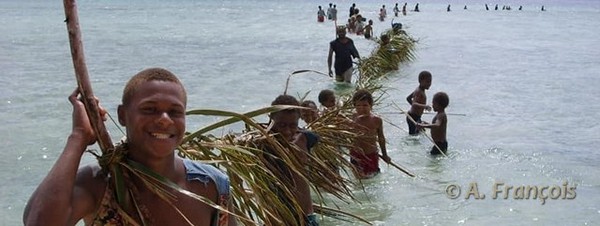
pull back ‹the fishing vine, na-hay› inland, so as to pen the fish insideresserrer progressivement ‹la liane de pêche na-hay› en remontant vers la plage, afin d'emprisonner le poisson
| Kēy wēhēy na-hay, tō vēyvēykal hay.They pulled back the vine and walked up inland.Ils resserrent la liane, et commencent à remonter vers la plage. |
wēl wɪl transitive verb
POc*poli
Redupwēlwēl
1 – buy ‹s.th.› (from s.o., den), trade money (traditional or modern, nē-sēm) for ‹s.th.›; pay ‹s.th.›acheter ‹qqch› (à qqn, den), échanger contre de l'argent traditionnel ou moderne (nē-sēm); payer
| Nok van wēl ta manmem suk hōw li-sto en.I'll go buy some sugar in the store.Je vais nous acheter du sucre au magasin. |
formal synonymvelet
n-ēm̄ wēlwēl noun
house for buyingstore, shopmaison des achatsmagasin, boutique
| Nok van l-ēm̄ wēlwēl.I'm going to the store.Je vais au magasin. |
loanni-sto
2 – pay ‹s.o.› a salary, typic. in moneypayer ‹qqn›, rétribuer les services de ‹qqn›, au moyen d'un salaire ou de toute autre compensation financière
| Nēk muwumwu nen en, kēy wēlwēl nēk si so nēk muwumwu mamah ēwē?For your work, are you being paid? or do you just work for free?Pour ton travail, est-ce que tu es payé, ou bien tu travailles gratuitement ? |
Anthropology
3 – manearn the symbolic rights upon ‹a hierarchical rank, t[a]mat▻⑤› by trading it ritually against certain goods, espec. traditional money (nē-sēm timigēn)hommeacquérir un droit symbolique sur ‹un grade hiérarchique, t[a]mat▻⑤›, en l'échangeant rituellement contre certains biens, partic. la monnaie traditionnelle (nē-sēm timigēn)
| No to-totot vēh n-ēvēp, veg no mē-wēl tō.I am allowed to sculpt a n-ēvēp demon, because I've reached that rank [lit. I bought it].J'ai le droit de sculpter une statue de démon n-ēvēp, car j'ai déjà atteint ce rang [litt. je l'ai acheté]. |
wēl na-tmat phrasal verb
Anthropology
purchase spiritsgo through the secret rituals earning access to a certain hierarchical rankacheter les espritsaccomplir les cérémonies secrètes permettant d'accéder à un certain grade hiérarchique
Acheter un démon ✧ Buying demons ✧ wēl na-tmat
Dans le cadre du parcours initiatique des hommes (nō-sōq), l'accession à chaque grade supérieur était conditionnée à certaines cérémonies impliquant l'argent traditionnel (nē-sēm), les fours à pierres (n-ep, na-qyēn̄i), le sacrifice d'un cochon (no-qo, na-yaw), etc. Chaque grade étant associé à un nom de “démon” (na-tmat), l'expression wēl na-tmat “acheter un démon” désigne l'acquisition des privilèges liés à ce grade.
During male initiation rituals (nō-sōq), the way for each candidate to reach a superior rank was done through a ritual involving traditional money (nē-sēm), stone ovens (n-ep, na-qyēn̄i), the sacrifice of a pig (no-qo, na-yaw), and so forth. Each rank was linked to the name of a “demon” (na-tmat): the phrase wēl na-tmat “purchase a demon” referred to the act of acquiring, through those rituals, the privileges attached to that rank.
Anthropology
4 – manearn the symbolic rights upon ‹a woman› by trading her ritually against a dowry: marryhommeacquérir un droit symbolique sur ‹une femme›, en l'échangeant rituellement contre une dot: épouser
| Talōw gēn van wēl na-lqōvēn.Tomorrow, we have a wedding [lit. we'll buy a woman]Demain, nous avons un mariage dans notre famille. [litt. nous achetons une femme] |
| Gēn sal nē-sēm apwo togop; wēl na-lqōvēn aē.You lay the money on top of the laplap pudding: this is how you marry a woman.On pose l’argent sur le laplap: c'est ainsi que l'on épouse une femme. |
synonymleg
seewoslēgē
wēl na-lqōvēn phrasal verb
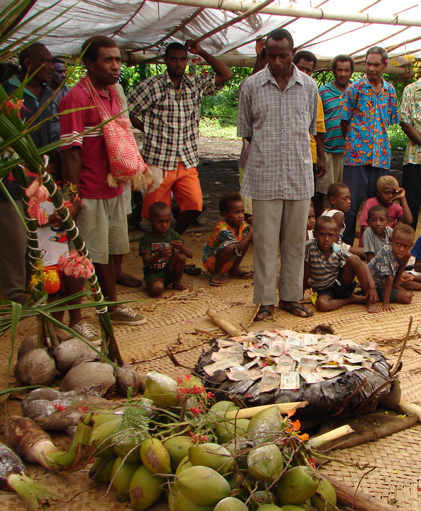
manbuy a womanwed, marry, in a traditional ceremony involving the offering of goodshommeacheter une femmese marier, en effectuant une compensation matrimoniale
Acheter une femme ✧ Buying a wife ✧ wēl na-lqōvēn
Gēn matyak le-mtap, gēn ōw na-qan̄yis, gēn lepyak na-tgop hinag. Gēn sal nē-sēm apwo togop, gēn lep ni-hnag vitwag mey a ni-lwo, gēn lep nu-qul motow, nē-n̄ē wōh; mōk tiwag mi na-tgop. Na-haphap del nen, wēl na-lqōvēn aē.
“Le matin au réveil, on déploie le four, et on en retire le laplap d'igname. On dépose l'argent sur le laplap, puis on apporte une igname de grande taille, un bouquet de cocos germés, un paquet de cocos frais, et on les pose à côté du laplap. C'est avec tous ces objets que l'on “achète” une femme.”
“Upon waking up in the morning, we unfold the oven, and take out the yam pudding. After laying the money on top of the pudding, we bring a large yam, a bunch of germinated coconuts, and a pack of fresh coconuts, and put them down besides the pudding. All these things are used when “buying” a wife.”
w[ē]lēwlēs wɪlɪwlɪs intransitive verb
move to free oneself from a physical constraint, struggle remuer pour s'affranchir d'une contrainte physique, se débattre
wē lok wɪlɔk intransitive verb
2 – s.o.get well again, after having been unwell; recoverqqnse sentir mieux après s'être senti mal; être de nouveau sur pied; guérir
| Kē mo-gom tō, ba kē mal wē lok.She was sick, but now she has recovered.Elle était malade, mais elle est déjà guérie. |
| Nō-wōgit mino gēn, ba no ne-myōs so nēk so galeg wē lok kē.causative with galegMy noble son, I want you to resurrect him.causatif avec galegMon noble enfant, j'aimerais que vous le guérissiez. |
Wēmut wɪmut proper noun
Wemut, nickname for a person with twisted or infirm limbs Wemut, surnom d'une personne aux membres tordus ou infirmes
| Wēmut, WēmlagWemut and Wemlag (a famous children's tale) Wemut et Wemlag (célèbre conte pour enfants) |
seemut
wēt1 wɪt intransitive verb
Redupwētwēt
appear, emerge, become visibleapparaître, émerger, devenir visible
| N-et wēt kal tō gēn!diver+Look, someone's coming out of the water!plongeur+Regarde, il y a quelqu'un qui émerge (de l'eau) ! |
wēt2 nē-wēt nɪwɪt noun
Cf. w‹ē›ti~
Flora
branchbranche
synonymnē-wti
wēt3 nē-wēt nɪwɪt noun
Lo-Togane wēt
Music
“néwét”: a song genre“néwét”: genre de chant
| Nē-wēt, na-qtēqtēg nan: “O a ee…”Néwét songs begin like this: “O a ee…”Le néwét a toujours pour incipit “O a ee…” |
| No ne-myōs so nēk tow na-hek a– mi nu-tun ne wēt, tō ta-laklak vēh aē.I want you to compose an ode about me, with a tune of néwét, so people can dance to it.Je veux que tu me composes une ode avec une mélodie de néwét, pour que l'on puisse danser dessus. |
w‹ē›tē nē-wtē nɪwtɪ noun
Motaiwatia
outrigger boom: wooden yokes joining the outrigger (na-sam) to the hull (na-taqn̄ēn, na-tqe ok)joug de la pirogue: barre horizontale, génér. au nombre de trois, reliant le balancier (na-sam) à la coque (na-taqn̄ēn, na-tqe ok)
| Teteh qēt bah na-taqn̄ēn, tō kē me-teh na-sam nan, nē-wtē tiwag mi nē-mtot.Once he had cut the (canoe) hull, he started carving the outrigger, the yokes, and the connective sticks.Après avoir sculpté le corps (de la pirogue), il taille le balancier, les jougs, et les chevilles d'attache. |
see lexical list atni-siok
w‹ē›tēwti~ nē-wtēwti nɪwtɪwti
ni-wtiwti
noun, relational
Red. w‹ē›ti~ ‘branch’
3snē-wtēwtēn
treesmall branches, in large numberarbrepetites branches, en grand nombre
| nē-wtēwti gēvēgthe small branches of the Malay appleles petits branchages du Pommier canaque |
seenē-wēt
w‹ē›ti~ nē-wti nɪwti
ni-wti
noun, relational
3snē-wtēn
Flora
treebrancharbrebranche
| nē-wti qētēngea tree branchbranche(s) d'arbre |
| Nē-wtēn mo-lol helhel.Its branches were spreading far.Les branches se déployait loin. |
wēy °na-wēy nawɪj noun
<°ná wowóruMotawowora round fish-trap
Techniques
small river shrimp trap (n-ēyēy), specifically used in Gauapetite nasse à crevettes de rivière (n-ēyēy), utilisée spécialement à Gaua
| Na-wēy en, b-ēyēy ēwē.The nawēy trap is only used for shrimp. La nassette nawēy ne sert que pour les crevettes. |
wēydēs nē-wēydēs nɪwɪjⁿdɪs noun
Motaweru
Birds
Long-tailed Triller, black and white bird, 18 cmÉchenilleur Pie, oiseau noir et blanc, 18 cmLalage leucopyga.
wēywēy wɪjwɪj intransitive verb
wik ni-wik niwik noun
Eng.week
Tps
weeksemaine
| li-wik mey a ma-bahlast week la semaine dernière |
| li-wik mey vanvan tō agōhnext week la semaine qui vient |
📙 Il semble que la semaine ancienne (sans nom connu) avait une base quinaire: dans les textes traditionnels, on compte souvent les jours par cinq ou dix.
📘 It seems that the ancient week (with no known name) had a quinary base: in traditional texts, days are often counted in groups of five or ten.
w[i]nignig winiɣ̞niɣ̞
w[i]niwnig
adjective
2 – plural subjectclose to each other, compact, densesujet plurielresserré, compact, dense
| Na-yte nan ne-tnenen ba ne-wniwnig.The lines are straight and close to each other.Les lignes sont droites et resserrées. |
| So vetvet na-tamge en, ne-wnignig a ne-wnignig.When you weave a pandanus mat, (you have to weave it) very compact.Quand on tresse une natte de pandanus, (il faut tresser) très resserré. |
wistaban ni-wistaban niwistaᵐban noun
Flora
variety of kava with pale flesh, bsl. waetkavavariété de kava plus pâle que les autres, bsl. waetkavaMacropiper spp.
w[i]yis wijis transitive verb
Redupw[i]yiwyis
1 – manipulate ‹s.th.› carefully to improve or repair it: adjust, tinker, fix; (hence) repairmanipuler ‹qqch› avec minutie, de façon à l'améliorer ou le réparer: ajuster, bidouiller, bricoler; (d'où) réparer
| wiyis n-ep tō kē ni-lawlawadjust (the wood in) the fire to revive it ajuster (le bois dans) le feu pour le raviver |
| n-et wiyiwyisthe repairer le réparateur |
| Nēk so wiyiwyis ni-vidio mino.Can you try to fix my VCR? Tu peux essayer de réparer mon magnétoscope? |
| Japan, kem ōl so “na-pnō wiyiwyis haphap”, veg nē-mēnay ni-plaplag galsi.We nickname Japan “the country of tinkering,” because they are very ingenious. Nous surnommons le Japon “le pays de la bidouille”, car ils sont très ingénieux. |
2 – figfiddle with; rack ‹o.'s brains›figtrifouiller, triturer
| Ige tēytēybē ne gatgat, kēy wiyiwyis nō-sōl nonoy aē!Linguists, they rack their brains with these questions! Les linguistes, ils se triturent les méninges avec ces questions-là! |
1 – manipuler ‹qqch› avec minutie, de façon à l'améliorer ou le réparer: ajuster, bidouiller, bricoler; (d'où) réparer
| wiyis n-ep tō kē ni-lawlawajuster (le bois dans) le feu pour le raviver |
| n-et wiyiwyisle réparateur |
| Nēk so wiyiwyis ni-vidio mino.Tu peux essayer de réparer mon magnétoscope? |
| Japan, kem ōl so “na-pnō wiyiwyis haphap”, veg nē-mēnay ni-plaplag galsi.Nous surnommons le Japon “le pays de la bidouille”, car ils sont très ingénieux. |
w[i]yiwyiy1 wijiwjij transitive verb
color, paintcolorier, peindre
| Kēy wiyiwyiy n-ēm̄.They are painting the house. Ils sont en train de peindre la maison. |
| Picasso kē n-et wiyiwyiy haphap.Picasso, he is a painter [a person who colors things].Picasso, c'est un peintre [une personne qui colorie les choses]. |
w[i]yiwyiy2 na-wyiwyiy nawjiwjij noun
Dér. from w[i]yiy ‘grind’
1 – action of grinding or crushing, reducing into small pieces ‹wood, root+›; esp. action of grinding the kava root (na-ga) to prepare it for consumption action de moudre ou pulvériser, de réduire en petits morceaux ‹bois, racine+› ; part. action de moudre la racine de kava (na-ga), afin de la préparer à la consommation
wo1 wɔ
Apredicative
with optional subjectquotative particle, introducing reported speechprécédé ou non d'un sujetparticule déclarative, introduisant le discours rapporté direct
Binterjection
utterance-final…you rather mean? …don't you rather think? Consists in politely contradicting the addressee, while checking their approvalen fin d'énoncé, intonation postrhème…ou plutôt, tu veux dire…? …tu ne penses pas plutôt que…? Consiste à contredire poliment son interlocuteur, tout en lui demandant son assentiment
| Nok vap te-le-lam, wo?I guess I should speak in Bislama, rather?Je ferais mieux de parler en bislama, non? |
| Tog ak magaysēn nēk, wo!polite contradictionNo, don't you take trouble for me!contradiction polieMais non, mais non, ne te dérange pas! |
Csubordinator
1 – combined to sowo, or alonemarker of hypothesis: if, if evercombiné à sowo, ou seulmarque d'hypothèse: si, si jamais
| Sowo no wo m-ēh, nok van lok me.In case I survive, I'll come back.Si jamais je survis, je reviendrai. |
synonymso ① ⓒ▻⑥
2 – rarecomplementizer, in a hypothetical context (instead of so ① ⓒ▻②)raremarque de complétive en contexte hypothétique (au lieu de so ① ⓒ▻②)
| Ige tegha wo ne-myōs wo yon̄teg, kēy yon̄teg.If the others want to listen [lit. want that they listen], let them listen.Si les autres veulent écouter [litt. veulent qu'ils écoutent], ils n'ont qu'à écouter. |
wo-2 wɔ prefix
POc*puaqfruit; bear fruit
semi-productive prefix for certain fruitpréfixe semi-productif pour certains fruits
main entrywō- ③
wo-3 wɔ prefix
North-V*wonoun article
(?) wo- ② ‘fruit’
1 – honorific prefix, replacing na- with certain nouns, gener. to form the name of a person or characterpréfixe honorifique, remplaçant na- pour certains noms, génér. pour former le nom d'une personne ou d'un personnage
| wo- + m‹ē›nay → Wēmnaywise, smart → the Wise (a character)sage, intelligent → le Sage (nom d'un personnage) |
| wo- + m[ō]dō → Womdōorphan → Orphan (a character)orphelin → Orphelin (nom d'un personnage) |
woden̄den̄ no-woden̄den̄ nɔwɔⁿdɛŋⁿdɛŋ noun
Ocean
Strombus, a kind of marine shellStrombe, sorte de coquillage marin
woh1 no-woh nɔwɔh noun
POc*posepaddle
woh3 wɔh transitive verb
Redupwowoh
1 – strike with an open hand: slap, give a smack to ‹s.o., s.th.›frapper avec la main ouverte: gifler, donner une claque à ‹qqn, qqch›
| Woh na-mnengēn![Let's clap our hands] Let's applaud![Claquons nos mains] Applaudissons! |
| Ēgnōn ni-boel kē tō, ni-vēygēl kē, ni-woh kē, ni-lm̄eh kē.Her husband would get angry at her, argue with her, slap her, flog her…Son mari entrait dans des accès de colère, lui hurlait dessus, la giflait, la fouettait… |
woh lō wɔhlʊ transitive verb
1 – vulgslap firstdeflower, take the virginity of ‹a woman› vulgfrapper inaugurerdéflorer, dépuceler ‹une femme›
2 – metphjoculinitiate ‹s.o.› (to, be-); introduce ‹s.o.› to s.th.métphplaisinitier ‹qqn› (à, be-); faire découvrir qqch à ‹qqn›
| Nok a mo-woh lō nēk ba-gatgat to-M̄otlap en.It's me who introduced you to Mwotlap. […me who "deflowered" you in this language] C'est moi qui t'ai fait découvrir le mwotlap. […moi qui t'ai dépucelé dans cette langue] |
wolat wɔlat postverb
Cf. lat
after motion Vwhile crossing, cutting across ‹path, river+›, esp. in a way that blocks the path to othersaprès V de mouvementen traversant, en coupant à travers ‹chemin, rivière+›, spéc. de manière à barrer le chemin à autrui
| Tateh et ni-van wolat goy na-mtehal.No one crosses the road.Personne ne traverse la route. |
wolkokon̄ay no-wolkokon̄ay nɔwɔlkɔkɔŋaj noun
2 – Australian boxwood, a tree (Sapotaceae), bsl. Kombtriou bienarbre (Sapotacées), bsl. KombtriPlanchonella linggensis.
📙 Cette plante a des piquants (sokoskoy).
📘 This plant has thorns (sokoskoy).
wolwol wɔlwɔl
MotawolowoloPEO*polos, polos-icut across, sever
Aadjective
across, transverse, perpendicularen travers, transversal, perpendiculaire
| n-ayte vōyō n-en wolwol[two lines lying across] two perpendicular lines[deux lignes en travers] deux lignes perpendiculaires |
womdō no-womdō nɔwɔmⁿdʊ
PNCV*maduaalone, separate, orphanPOc*mad(r)awaorphaned, separate
womlōw no-womlōw nɔwɔmlʊw noun
Ocean
cowrie, a small non-edible shell (3 cm)cyprée ou cauri, coquillage non comestible de petite taille (3 cm)Cypraea teramachii.
NBJeuSa forme plus petite, nō-wōqōl, n'est pas comestible, mais est utilisée notamment dans un jeu, tōqōl hohole.
Womtelo wɔmtɛlɔ strong noun
MotawometeloaPTB*wo mata-i aloaeye of the sun: rising sun, Orient; a chiefly rank
Anthropology
1 – Rising Sunthe highest rank in the grade-taking system (nō-sōq)Soleil Levant (Cf. mete lo)le plus haut grade dans le système à grade (nō-sōq)
2 – metonman characterised by a luxurious life, with numerous wivesmétonpacha, homme caractérisée par une vie de luxe, aux nombreuses épouses
| Bōbō nōnōm, kē no-Womtelo !jocYour grandfather was a real king! (he had many wives in his life)plaisTon grand-père, c'était un vrai pacha ! (car il a eu de nombreuses femmes dans sa vie) |
womtigtig no-womtigtig nɔwɔmtiɣ̞tiɣ̞ noun
📙 Suivant un usage des îles Salomon, cette noix est parfois mâchée (kam) avec une feuille particulière (no-yogehmyaw) mélangée à de la chaux (na-laem)
📘 Following a usage from Solomon islands, this nut may be chewed (kam) together with a specific leaf (no-yogehmyaw), and coral lime (na-laem)
wom̄elm̄el no-wom̄elm̄el nɔwɔŋ͡mʷɛlŋ͡mʷɛl noun
finrequinaileron
| No-wom̄elm̄el ne bago kē ni-sak lō me am̄ag.The shark's fin is the first thing that appears. L'aileron du requin, c'est la première chose qui apparaît. |
won1 wɔn
Motawonaa stone platform+; a fish fence
Atransitive verb
Techniques
assemble ‹stones› to build a low wall or similar structureassembler ‹des pierres› afin d'édifier un muret, ou toute autre construction similaire
| Kēy mo-won ne-vet; qe so ne-geay ne qo.With stones, they had built an enclosure, similar to a pigpen. Avec des pierres ils avaient construit un enclos, semblable à un enclos de cochon. |
Bnounno-won
Archaeology
podium, tribune: stone platform slightly raised above the ground, from which important chiefs, in the past, addressed their subjects podium, tribune: plateforme de pierre légèrement surélevée au-dessus du sol, du haut de laquelle les chefs importants, autrefois, s'adressaient à leurs sujets
| No-won a ige welan kēy tigtig am̄ag aē, tō toytoy ige sil aē.The no-won tribune is the place where, in the past, chiefs stood to harangue the crowd. La tribune no-won, c'est l'endroit où autrefois les chefs se dressaient pour haranguer la foule. |
| Qiyig nōk, le-ngomi sil del nōk, nok vay mat no-moyuk hōw lo-won mino gēn.taleIn a moment, before all of you my subjects gathered here, I will kill my nephew, right here, on this podium of mine. conteDans un instant, devant vous tous mes sujets ici réunis, je vais mettre à mort mon neveu, ici même, sur ce podium qui est le mien. |
synonymwonwon
Les tribunes de pierre ✧ no-won
Les mythes et légendes représentent souvent les grands chefs d'autrefois dressés sur une estrade de pierre, pour haranguer (toytoy) la foule de leurs sujets lors des cérémonies importantes (cf. kolkol).
Si ces tribunes de pierre n'existent plus de nos jours, on peut cependant en voir les vestiges archéologiques dans certains sites d'anciens villages (no-wonwon), aujourd'hui recouverts par la végétation (ex. Tavalwowoh, près d'Aplow).
Myths and legends often depict great chiefs of the past standing on a stone platform, to address (toytoy) the crowds of their subjects during important ceremonies (cf. kolkol).
While these stone platforms no longer exist today, archaeological remains can still be seen at some sites of ancient villages (no-wonwon), now covered by vegetation (ex. Tavalwowoh, near Aplow).
won2 wɔn
Motawonoclose, fill up+; pay a debt; solid+POc*ponotto close up; be full, complete
Atransitive verb
Redupwonwon
make ‹s.th.› complete or whole; restore the integrity of ‹s.th., s.o.› rendre ‹qqch› complet ou entier; rétablir l'intégrité de ‹qqch, qqn›
1 – fill ‹a hollow object› to fill its emptiness; fill, plug, pad ‹s.th.›remplir ‹un objet creux› de manière à en combler le vide; combler, boucher, rembourrer ‹qqch›
synonymwon goy
2 – reassemble ‹s.th. that has been dismembered› by putting its pieces back togetherreconstituer ‹qqch qui a été démembré› en en assemblant à nouveau les morceaux
| Na-myaw me-lep ni-gintatay, tō kē ni-won na-taqm̄ē qētēnge nen en. Kē mo-won, mo-won, mo-won, won won won won qēt wah – kē ni-vētgiy tenenen lok hag!Iqet has hollowed a tree trunk to carve his canoeThe spider gathers the wood chips and starts to reassemble the tree trunk. Once the tree is reassembled [lit. she fills it, fills it, fills it...], she even goes so far as to stand it back up! Iqet a évidé un arbre pour s'y tailler sa pirogueL'Araignée ramasse les copeaux, et se met à reconstituer le tronc d'arbre. Une fois l'arbre reconstitué [litt. elle le rebouche, le rebouche, le rebouche…], elle va même jusqu'à le remettre sur pied ! |
synonymwon lok
Anthropology
3 – sorceressresurrect ‹a dead person› by magically reassembling themsorcièreressusciter ‹un mort› en le reconstituant magiquement
| Kē me-qtēg won qētēg lē-qtēn. Kē mu-suw kē mi ne-m̄el nen, mo-won na-taqm̄ēn nen; mo-won, mo-won i won i won en mo-won qēt kē van en mi ne-m̄el nen.(The sorceress) began by reassembling his head. Then she bathed him in a preparation of Cycas palm leaves to reassemble his body. She continued like this, again and again, until she finally completely reassembled him, thanks to this palm tree. (La sorcière) commença par reconstituer sa tête. Puis elle le baigna dans une préparation de feuilles de palmier Cycas, afin de reconstituer son corps. Elle continua ainsi, encore et encore, tant et si bien qu'elle finit par le reconstituer complètement, grâce à ce palmier. |
Une patiente résurrection ✧ won
Dans plusieurs contes, un héros meurt, avant d'être patiemment ressuscité par une sorcière (magtō) bienveillante. Loin d'être immédiat, le retour à la vie n'est possible qu'après un lent processus magique de reconstitution du corps (won ‘rétablir l'intégrité de qqch’). La sorcière applique des feuilles magiques (nē-tēnge) sur chacune des parties du corps, les unes après les autres, de manière à les ranimer successivement. Après cinq jours, le défunt finit par retrouver la vie (ēh lok). Kē mo-won nēk bō-qōn̄ tēvēlēm. Lō-qōn̄ tēvēlēm-negi e tō nēk ēh lok. ‘Pendant cinq jours, elle t'a reconstitué. Et puis, le cinquième jour, tu as retrouvé la vie.’
In several tales, a hero dies, only to be patiently resurrected by a benevolent witch (magtō). Far from being immediate, the return to life is only possible after a slow, magical process of reconstituting the body (won ‘reconstructing the integrity of s.th.’). The witch applies magical leaves (nē-tēnge) to each part of the body, one after the other, in order to revive them successively. After five days, the deceased finally comes back to life (ēh lok). Kē mo-won nēk bō-qōn̄ tēvēlēm. Lō-qōn̄ tēvēlēm-negi e tō nēk ēh lok. ‘For five days, she restored you. And then, on the fifth day, you came back to life.’
4 – reciprocate a favor by restoring the balance of exchange: e.g. repay a debt, offer compensation or retributionfigrépondre au bienfait d'autrui d'une manière qui rétablisse l'équilibre de l'échange: ex. rembourser une dette, offrir une compensation ou une rétribution
seeyam goyrembourserrepay
synonymwon goy
won-eh intransitive verb
Music
fulfill the songrefers to the final moment of the inauguration ceremony of a prestigious ode (se lō*), when the sponsor of the song offers gifts (yams, salted cake na-tgop) and especially money (nē-sēm) to the poet and singers, in retribution for their effortscombler le chantdésigne le moment final de la cérémonie d'inauguration d'une ode de prestige (se lō*), lorsque le commanditaire de la chanson fait offrande de présents (ignames, gâteau salé na-tgop) et surtout d'argent (nē-sēm) au poète et aux chanteurs, en rétribution de leurs efforts
| Mey a na-tgop tō nēk sal nē-sēm hōw aē en, mey nen ‘won-eh’: nēk won na-he ēgēn.The moment when you place money on the yam cake is called ‘won-eh’: because this is how you “fulfill your song.” Le moment où tu déposes de l'argent sur le gâteau d'igname, c'est ce qu'on appelle ‘won-eh’: car c'est de cette façon que tu “combles ton chant”. |
Badjective
1 – without opening, compact, closedsans ouverture, compact, fermé
| nē-m̄ēt won[compact forest] the deep forest [forêt compacte] la forêt profonde |
Csuffix
lexical suffix, used in some compounds, metaphorically evoking an obstruction (of the body or mind)suffixe lexical, entrant dans quelques composés, et évoquant métaphoriquement une obstruction (du corps ou de l'esprit)
| qoywon*[blocked ears] deaf [oreilles bouchées] sourd |
| qētwon*[blocked head] stubborn, obstinate [tête bouchée] têtu, obstiné |
| lolwon*[blocked inner-self] sad, melancholic [for-intérieur bouché] triste, mélancolique |
wonn̄eg wɔnŋɛɣ̞ transitive verb
release ‹s.th., s.o.›, rather violently; drop, abandonlâcher ‹qqch, qqn›, plutôt violemment; jeter, abandonner
| Tita nonon ni-wonn̄eg veteg se tētē hōw le-skey.The mother abandons the baby again on the reef. La mère abandonne à nouveau le bébé sur le récif. |
wonwon1 no-wonwon nɔwɔnwɔn noun
Motawonawonastone platform+
2 – remains of an ancient village, taking the form of various stone artifacts (tribune, low walls, stone ovens)par extvestiges d'un village ancien, prenant la forme de divers artéfacts de pierres (tribune, murets, fours à pierre)
| no-wonwon ne vōnō t-am̄agthe remains of an ancient village les vestiges d'un village ancien |
wonwon2 wɔnwɔn
POc*ponotto close up; be full, complete
Redup. won ②
Aadjective
1 – full, completeplein, complet
2 – espmoonfull; be full moonspéclunepleine
| Nō-wōl isqet so ni-wonwon.The full moon is coming soon. C'est bientôt la pleine lune. |
3 – intact, uncorruptedintact, qui n'a subi aucune corruption
| Nō-yōwismat, kē no-yova a no-wonwon, a et-ōw qete.The yōwismat is an intact banana leaf that has never opened. Le yōwismat, c'est une feuille de bananier intacte, qui ne s'est encore jamais ouverte. |
| Nok lep n-eh mino van hiy nēk en, mi na-tamtam, a no-wonwon, et-mahay hōn te.metaphI entrust my song to you in a spirit of peace, a complete and flawless peace. métaphJe te confie mon chant dans un esprit de paix, une paix entière et sans fêlure. |
wonyeg wɔnjɛɣ̞ transitive verb
“do” ‹s.th.›, take care of ‹s.th.›: generic verb with an indefinite meaningrare“faire” ‹qqch›, s'occuper de ‹qqch›: verbe générique, au sens indéfini
| wonyeg n-ēm̄take care of the house (build it, repaint it, dismantle it...) s'occuper de la maison (la construire, la repeindre, la démonter…) |
| Nēk wonyeg se na-gatgat to-M̄otlap en, aa?You (speak) Mwotlap well, don’t you? Tu (parles) bien le mwotlap, n'est-ce pas? |
| Ne-len̄wuh mo-wonyeg n-ēm̄ mino.The cyclone (destroyed) my house. Le cyclône a (détruit) ma maison. |
| wonyeg na-lqōvēntake care of a woman (beat her, sleep with her...) s'occuper d'une femme (la battre, la besogner…) |
won̄ey no-won̄ey nɔwɔŋɛj noun
Art
2 – by analogy of shape, refers to a geometric motif in traditional pictorial art: the diamondpar analogie de forme, désigne un motif géométrique dans l'art pictural traditionnel: le losange
TabouCe motif est souvent associé aux chevrons gauches et droits (na-balbe gētē).
📘 This pattern is often associated with left and right chevrons (na-balbe gētē).
seedaemancarreaux (cartes)diamond (cards)
Wopnō wɔpnʊ placename
rarethe islandrefers to the main island par excellence, Espiritu Santorarel'Îledésigne la grande île par excellence, Espiritu Santo
| ige to-Wopnōthe people of Santoles gens de Santo |
seevōnō
loanSado
wopyak no-wopyak nɔwɔpjak noun
MotavarakePEO*paRagetree sp., Pangium edule; dance rattles
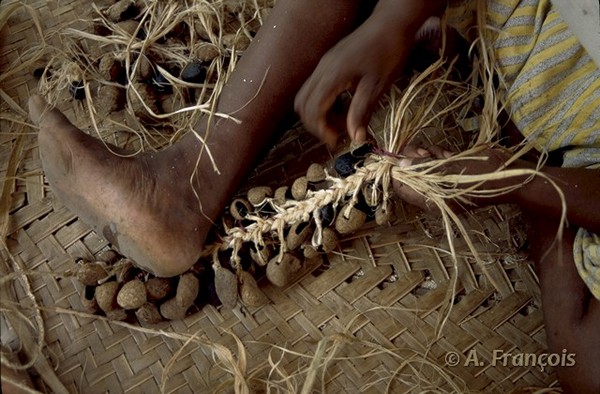
Flora
1 – Ankle rattle tree: a tree whose fruit is used to make ankle rattlesarbre fruitier dont on fait les sonnailles pour la danse traditionnellePangium edule.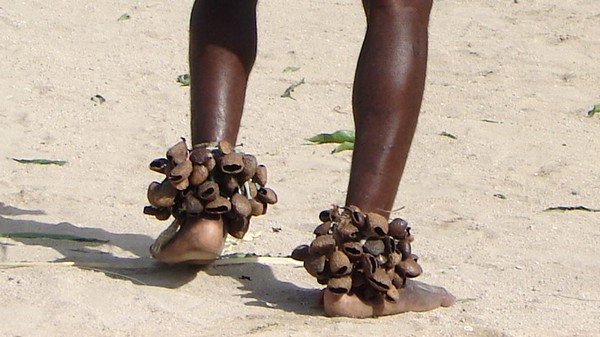
Dance
2 – rattles used in traditional dancing, tied around men's ankles for the dances na-mag or ne-qetsonnailles de danse, noués aux chevilles des hommes pour les danses na-mag ou ne-qet
📙 Les sonnailles sont exceptionnellement réunies dans un sac, et agitées à la main, dans le cadre du na-wha titi.
📘 The rattles are exceptionally held in a bag and shaken, as part of the na-wha titi musical formation.
synonymna-pyak
wos wɔs
Motawoso
Bintransitive verbwoswos
Techniques
nail multiple objects, nail for a certain time; hence, tinker, engage in DIY or carpentryclouer plusieurs objets, clouer pendant un certain temps ; d'où bricoler, s'adonner au bricolage ou à la menuiserie
| Nēk n-et woswos vitwag, aa?You are a handyman! Toi tu es un bricoleur ! |
wosdi wɔsⁿdi transitive verb
Techniques
strike ‹s.th.› with the palm of the hand to make a slapping sound; specifically, slap the surface of the sea to scare fish and drive them toward the net during collective fishing (cf. gey hay)frapper ‹qqch› avec la paume de la main, pour provoquer un bruit claquant ; spéc. frapper la surface de la mer pour effrayer le poisson et l'attirer vers le filet, lors de la pêche collective (cf. gey hay)
| Ige lōqōvēn a mo-wosdi en, nō-mōmō mō-m̄ōl e kē ni-van yow.When the women started slapping (the water), the fish suddenly swam away toward the open sea.Quand les femmes se sont mis à claquer (l'eau), le poisson est soudain reparti en direction du large. |
woslēgē wɔslɪɣ̞ɪ
Motawosolagia
Aintransitive verb
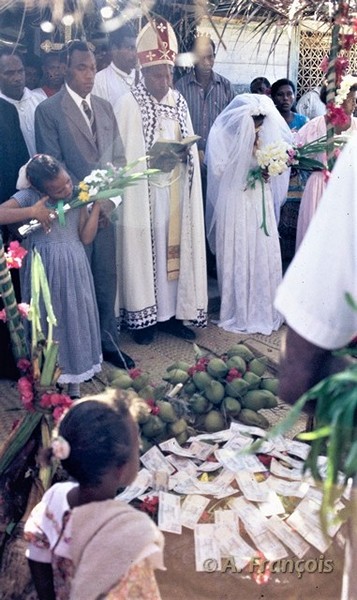
Anthropology
manbuy a woman, get married; complete the marriage ceremonyhommeacheter une femme, se marier ; accomplir la cérémonie du mariage
| Gēn so tey na-tgop n̄ey gōh, so to-woslēgē aē talōw le-mtap.We'll take this almond pudding, and use it tomorrow morning for the wedding ceremony.On va prendre ce laplap d'amandes, et l'utiliser pour le mariage demain matin. |
Bnounno-woslēgē
wedding ceremony, whereby the groom's family provides gifts and money to the bride's familycérémonie de mariage, au cours de laquelle la famille du marié offre des cadeaux et de l'argent à la famille de la mariée
wosnalgē wɔsnalɣ̞ɪ intransitive verb
Cf. l[ē]gē ‘wedding’
Anthropology
manmarry, wed: designates the act of marriage on the wedding day, consisting in (for the groom) exchanging a wife for possessionshommeépouser, se marier: désigne l'acte de mariage le jour des noces, consistant, pour la famille du marié, à échanger une femme contre des biens
| Wosnalgē, nē-dēmdēm nan so: wos nalgē, gēn wēl na-m̄alm̄al nōnōm.The expression “wos nalgē” means that we're coming to acquire your daughter.L'expression “wos nalgē”, cela signifie que l'on vient acquérir ta fille. |
| Ohoo, kōyō tateh. So wosnalgē en, namun ige famlē noyō ēwē. Tō kōyō ti-higap vēh.No, they're absent. The traditional wedding only concerns the two families; so the bride and groom may be absent.Non, ils ne sont pas là. Le mariage traditionnel ne concerne vraiment que les deux familles : par conséquent, les mariés peuvent être absents. |
ÉtymologieD'une expression antérieure wos na-lgē, désormais inanalysable.
EtymologyFrom a former expression wos na-lgē, now unanalyzable.
main entrywoslēgē
wot1 wɔt intransitive verb
Redupwotwot
be bornnaître
| Kōyō del mo-wot lō-qōn̄ vitwag.They were born on the same day.Ils sont nés tous les deux le même jour. |
| No mo-wot M̄otlap.I was born in Motalava.Je suis né à Motalava. |
| Tigsas kē mo-wot e kē n-et, kē et-wot vu te me, kē mo-wot et.Jesus was born a person: he was not born a god, he was born human.Jésus est né homme: il n'est pas né Dieu, il est né humain. |
| nō-qōn̄-wotwot date of birth; birthdayjour de naissance; anniversaire |
derivativevawotengendrergive birth
wot2 wɔt
Motawota
wot3 wɔt intransitive verb
fishbite the hookpoissonmordre à l'hameçon
| Ni-til ni-van me tō ni-wot van la-gayga yapyap namu.The trevally is biting your line.L'orphie vient mordre sur ta ligne. |
synonymtey ③▻②
wothap wɔthap particle
otherwise, if notdans le cas contraire, sinon
| Kē ni-vasem no-yoy ēwē, wothap no-yoy het.It is a sign of good news, or on the contrary, bad news. C'est le signe d'une bonne nouvelle, ou au contraire d'une mauvaise nouvelle. |
seetahap
wotwotmehiy wɔtwɔmɛhij
wotwot-mehiy
strong noun
born afterwardsmiddle-born, younger (child or sibling). Born between the first-born (wotwotm̄ag) and the last-born (wotwottigiy).né aprèspuîné d'une fratrie: petit frère, petite sœur; second(e) fils ou fille. Né entre l'aîné (wotwotm̄ag) et le cadet (wotwottigiy).
wotwotm̄ag wɔtwɔtŋ͡mʷaɣ̞ strong noun
firstborn, elder (child or sibling)né en premier (m̄ag)aîné d'une fratrie: grand frère, grande sœur; fils aîné, fille aînée
| Wotwotm̄ag ni-hag lap, wotwottigiy ni-van.The older sister stayed, while the younger one walked away.L'aînée resta là, tandis que la cadette se mettait en chemin. |
| Wotwotm̄ag en ni-boel wotwottigiy so ni-vēhyu mi kē.The older brother became angry at the younger one, and was about to fight him.L'aîné était furieux contre le cadet, voulait se battre avec lui. |
| Wotwotm̄ag mino, na-han Mak.My older son is called Mak.Mon fils aîné s'appelle Mak. |
wotwotm̄ag goy transitive verb
rarebe firstborn overbe the elder sibling of ‹s.o.›rareêtre aîné surêtre l'aîné par rapport à ‹qqn›
| Inēk a no-wotwotm̄ag goy kemem en.You are our elder brother.C'est toi, notre grand frère. |
RemGoy suggère l'idée de supériorité et de protection.
📘 Goy suggests both higher status and protection.
seegoy ①▻⑧
wotwottigiy wɔtwɔtiɣ̞ij
wotwot-tigiy
wotwotigiy
strong noun
born afterlast-born, youngest (child or sibling)né aprèsbenjamin, cadet d'une fratrie: petit frère, petite sœur; second(e) fils ou fille
wow1 wɔw intransitive verb
Redupwowow
1 – be busy with something, be engaged in a continuous activityêtre affairé à quelque chose, se trouver occupé à telle ou telle activité continue
| Qele ave, kimi wow tō gōh ?How are you, you who are busy there? Comment allez-vous, vous qui vous trouvez affairés là? |
| Woqse sil taq tō hay en, kēy wow tō en na-hap ?There are many people gathered there: what are they busy with? Il y a beaucoup de gens regroupés là-bas: à quoi donc sont-ils occupés? |
2 – continue one's action or attitude; act or live in the same way for a certain periodcontinuer durablement son action, son attitude; agir ou vivre de la même façon pendant un certain temps
| Disko wow leptō, tō nok m̄ōl, tō mitiy.The disco party was still going on when I went to sleep. La soirée disco se poursuivait encore lorsque je suis rentré dormir. |
| No-gom nan mo-wow leptō.His illness continues (he is still sick).Sa maladie se poursuit (il est encore malade). |
3 – + Adj. or V or Nhave such and such an attitude, behave+ Adj. ou V ou Navoir telle ou telle attitude, se comporter
| wow qaqa[act stupidly] act foolishly; specifically, act lecherously toward women [agir stupide] faire l'imbécile; spéc. se montrer grivois à l'égard des femmes |
| wow susuact like a child, behave childishly agir en enfant, puérilement |
| wow lōqōvēn[act like a woman] have an effeminate attitude [agir femme] avoir une attitude efféminée |
4 – formal register+ so + Vintend to, wish to; tryregistre formel+ so + Vavoir l'intention de; essayer
| No mo-wow so yem nō-wōh, ba no me-yemyem lēlēge.I tried to climb the coconut tree, but I didn't succeed. J'ai essayé d'escalader le cocotier, mais je n'y ai pas réussi. |
| Nok wowow so wēl na-trak, ba tateh sēm.I would like to buy a car, but I don't have money. J'aimerais acheter une voiture, mais je n'ai pas d'argent. |
| Dō wow so dō so van tatal ēagōh.We should go for a walk. Nous devrions aller nous promener. |
wow yak hag intransitive verb
intend toavoir l'intention de
| Nok wow yak hag so nok so van Vila, ba no et-van si te.I intended to go to Vila, but I didn't go.J'avais l'intention de me rendre à Vila, mais je n'y suis pas allé. |
synonymso (ni-)▻⑦
5 – covet, dream of acquiring, eye (something, hiy ① ⓑ)convoiter, rêver d'acquérir, lorgner (sur qqch, hiy ① ⓑ)
| Nok wowow hiy na-lo nōnōm.I'm eyeing your watch.Je lorgne sur ta montre. |
seeveshiyconvoitercovet
6 – esp+ Direct. + hiy ① ⓒturn toward ‹s.o.›, be interested in ‹s.o.›; hence be attracted to, be in love withpartic+ Direct. + hiy ① ⓒse tourner vers ‹qqn›, s'intéresser à ‹qqn›; d'où être attiré par, être amoureux de
| Kē ni-wow van hiy na-lqōvēn : kē ni-tityēn kē.He expressed his desire for a woman, but she rejected him. Il exprima son désir envers une femme, mais celle-ci le repoussa. |
| Nēk wowow hiy kē?Are you in love with her? Tu es amoureux d'elle? |
wow2 no-wow nɔwɔw noun
Flora
wild variety of pandanus, not used for making matsvariété sauvage de pandanus, non utilisée pour les nattesPandanus spp.
woy1 wɔj postverb
Motaworaonly, merely, in vain
1 – only, just: restrictive for numeralsseulement, juste: Restrictif des numéraux
| Intik vōyō woy.I only have two children. Je n'ai que deux enfants. |
| lō-qōn̄ vitwag woy ēwēin a single day en une seule journée |
| Kōyō vitwag woy.[lit. they are only one] Both are identical. [litt. ils sont un seulement] Tous les deux sont identiques. |
woy2 wɔj transitive verb
MotaworoPOc*poRos, poRos-i-squeeze out, wring out (liquid)
wring out, squeeze ‹grated coconut› to produce coconut milk, to sweeten a dishpresser ‹de la coco rapée› pour en obtenir du lait de coco, pour adoucir un plat
| woy na-mtigsqueeze coconutpresser de la coco |
| na-mtig a woysqueezed coconutcoco pressée |
synonymkon̄
woy3 wɔj postverb
<°βoraPEO*pora(k), porak-i-break, damage
Redupwoywoy
1 – (do V) so as to break or split s.th. lengthwise(faire V) de manière à scinder qqch dans le sens de la longueur
| Tō, nok tot woy na-famlē ēgēn.This is how I divide the lineages.C'est ainsi que je divise les lignages. |
wō1 wʊ particle
formal registerclause-initialquestion markerregistre formelà l'initiale absoluemarque d'interrogation
| Wō ba-hap?Why?Pourquoi donc? |
| Wō am̄ag nēk mo-tog tō ave?Where were you living before?Auparavant, tu habitais où? |
| Wō nēk akteg qele gōh?What are you doing?Qu'es-tu donc en train de faire? |
📙 Marque facultative, employée en contexte poli.
📘 Optional marker, used in a polite context.
wō-3 wʊ prefix
POc*puaqfruit; bear fruit
semi-productive prefix for certain fruitpréfixe semi-productif pour certains fruits
wōgtag nō-wōgtag nʊwʊɣ̞taɣ̞ noun
Flora
kavarootkavaracine
| nō-wōgtag ne gaa head of kavaune racine de kava, un pied de kava |
seeq‹i›ti~▻③
wōh nō-wōh nʊwʊh noun
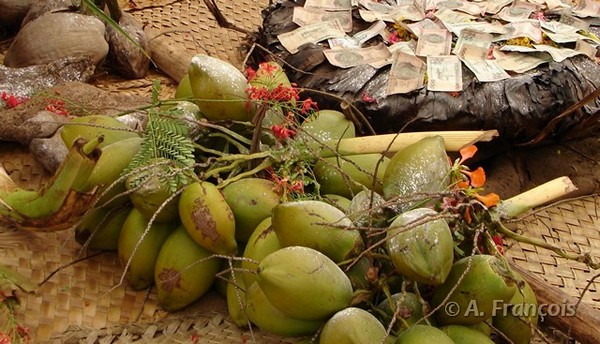
Flora
green coconut, picked for its juicenoix de coco encore jeune, cueillie pour son jusCocos nucifera.| Na-mtig e, kē ni-dam qele nen van i van en, kē ni-wōh, kē ni-myot, kē ni-wōmenmen kē ni-sisgoy.The coconut, over time, it will first be green-coconut, then sour coconut, then ripe coconut, and it will fall.La noix de coco, au fil du temps, sera d'abord coco-vert, puis coco-acide, puis coco-mûr, puis elle finira par tomber. |
see lexical list atna-mtig
wōit nō-wōit nʊwʊit noun
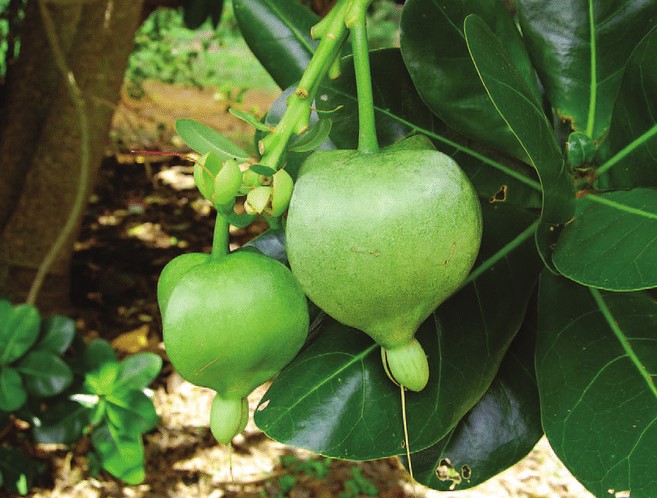
Flora
Fish Poison tree (Lecythidaceae), bsl. Navele blong solwotaChapeau d'évêque, bsl. Navele blong solwota: arbreBarringtonia asiatica.| Nō-wōit, heyeg nō-mōmō aē kē ni-mat.Nō-wōit is used to poison fish.Avec le nō-wōit, on empoisonne le poisson pour le tuer. |
wōkōl °na-wōkōl nawʊkʊl noun
Motawakole
Birds
Vanuatu Mountain White-bellied Honeyeater, a bird with a strongly downcurved bill, 20 cmMéliphage des Montagnes, oiseau au long bec recourbé, 20 cmPhylidonyris notabilis.
seewēydēs
wōl3 nō-wōl nʊwʊl
POc*pulan
Anoun
1 – la lune
| Nō-wōl ni-hin̄yeg tō ni-ak vētmahē ni-myemyen.The moon shines so brightly that it feels like daytime.La lune éclaire si bien qu'on (se croirait) en plein jour. |
| Nō-wōl me-hey goy na-pnō del.The moon illuminates the entire village. La lune illumine tout le village. |
| Nō-wōl ma-hal goy na-lo.solar eclipseThe moon passes in front of the sun.éclipse solaireLa lune passe devant le soleil. |
📙 Les phases de la lune portent des noms, énumérés ci-dessous, dans l'ordre ; ajouter na-n̄yen̄ye mēs lune en forme de bec de perroquet.
📘 The phases of the moon have names, listed below in order; add na-n̄yen̄ye mēs lune en forme de bec de perroquet.
na-mtehal ne wōl noun
the path of the moon, the different phases it goes through in a month le chemin de la lunele parcours de la lune, les différentes phases par lesquelles elle passe au cours d'un mois
nō-wōl wehey noun
young moonnew moonlune jeunenouvelle lune
| Nō-wōl wehey mo-togyow.The new moon has appeared.La nouvelle lune est apparue. |
nō-wōl (na-)gayte-gi noun
Art
half-moon. Specifically, a motif used in traditional pictorial art, crescent moon-shapeddemi-lune. Partic. motif employé dans l'art pictural traditionnel, en forme de croissant de lune
| Nok yap nō-wōl na-gayte-gi tekel-gi, tekel-gi nok yap na-tweh tēnge.On one side (of the sacred mask), I draw a crescent moon; on the other side, I draw a flower. D'un côté (du masque sacré) je dessine un croissant de lune, de l'autre côté je dessine une fleur. |
nō-wōl ni-tqetqe-qo phrase
the moon becomes pig-bellygibbous moon: moon filled to about two-thirdsla lune devient panse-de-cochonlune gibbeuse: lune remplie aux deux-tiers environ
nō-wōl ni-hn̄ēnwon phrase
the moon is filledit is the full moonla lune est complètement rempliec'est la pleine lune
seehēn̄ēnwon
Le calendrier traditionnel ✧ The traditional calendar ✧ nō-wōl
| nē-wētgoy | janvier | January |
| lam̄heg towowoh | février | February |
| tētnawon | mars | March |
| lam̄heg doydoy | avril | April |
| bōlbōltētdot ; wōlta | mai | May |
| wuyvegsa ; tētmalet | juin | June |
| napdum̄ōl | juillet | July |
| takle in-gon | août | August |
| n-in-gon | septembre | September |
| n-in-yig | octobre | October |
| n-in-lap | novembre | November |
| n-in-wey | décembre | December |
Time
2 – month, calendar periodmois, période du calendrier
| nō-wōl vitwag may bahone month ago il y a un mois |
| lō-wōl mey a ma-bah enlast month le mois dernier |
| lē-kle wōl vōyōin / after two months après / dans deux mois |
| lō-wōl agōhthis month ce mois-ci |
| Nēk mal tog vatag me gōh nō-wōl vēvēh? – Nō-wōl vitwag woy ēwē.How many months have you been here? – Just one month. Depuis combien de mois es-tu ici ? – Juste un mois. |
| Kōyō so leg l-ulsi wōl gōh, si so lō-wōl itan.They will get married at the end of this month, or next month. Ils vont se marier à la fin de ce mois-ci, ou bien le mois prochain. |
EthnologieLes mois portaient des noms traditionnels, connus auj. de qqs personnes seulement, et énumérés ci-contre. Auj., les noms des mois sont empruntés à l'anglais, et sont généralement précédés du mot wōl ③: ex. lō-wōl Februare en février, etc.
📘 The months had traditional names, known today by only a few people, and listed here. Today, the names of the months are borrowed from English, and are generally preceded by the word wōl ③: e.g. lō-wōl Februare in February, etc.
wōlan̄ nō-wōlan̄ nʊwʊlaŋ noun
Art
geometric pattern in traditional pictorial art, M-shapedmotif géométrique dans l'art pictural traditionnel, en forme de M majuscule
wōlēlē nō-wōlēlē nʊwʊlɪlɪ noun
Flora
bract: leaf-like structure protecting the inflorescence of a plantbractée: enveloppe foliacée protégeant l'inflorescence d'un végétal
| Nō-wōlēlē ni-mwoy, tō ni-n̄i mitig ni-kalō.The bract splits, and the coconut inflorescence emerges. La bractée se fend, et laisse sortir l'inflorescence du cocotier. |
wōmn̄as nō-wōmn̄as nʊwʊmŋas noun
Flora
coconut spathe: leafy sheath that encloses spadix (cluster of flowers)spathe du cocotier (na-mtig*): longue gaine rigide et fendue, qui enveloppe l'inflorescence
| Nō-wōlēlē ni-mwoy, tō ni-n̄i mitig ni-kalō; ba nō-wōmn̄as e, na-tn̄an.La bractée se fend, et laisse sortir l'inflorescence du cocotier; le ‘spathe’ désigne l'enveloppe elle-même. |
wōm̄ēl nō-wōm̄ēl nʊwʊŋ͡mʷɪl noun
POc*moliscitrus fruit or citrus-like fruit
orangeorange
| ni-gli wōm̄ēlorange juice jus d'orange |
synonymnē-m̄ēl
loanaranis
nō-wōm̄ēl sekeske noun
orange to throwpomelo or large orangeorange à lancerpamplemousse ou grosse orange
JeuAutrefois, ces gros fruits étaient utilisés par les enfants comme ballon, qu'ils se lançaient les uns aux autres (sekeske).
AnthropologyFormerly, these large fruits were used by children as balls, which they threw to each other (sekeske).
Games
2 – metphball, football or esp., volleyballmétphballe, ballon de football ou spéc. de volley-ball
| Kēy sekeske wōm̄ēl en, a so kēy plevolē en.jocul“They throw the pomelo to each other”: this means they're playing volleyball!plais“Ils se lancent le pamplemousse”, ça veut dire qu'ils jouent au volley ! |
| sēmteg / kikik wōm̄ēlplay football jouer au football |
| na-hye kikik wōm̄ēlfootball field terrain de football |
ModLes sports de balle favoris des gens de Mwotlap sont le football (kikbol) pour les hommes, et le volley-ball pour tous.
ModThe favorite ball sports of the people of Mwotlap are football (kikbol) for men, and volleyball for everyone.
seenō-wōkikikballon de footfootball
wōnuy mitig wʊnuj mitiɣ̞ noun
Cf. nuy
(strong enough to remove) the coconut fiberthumb(assez fort pour retirer) la bourre de cocopouce
seeqētbuhudoigtfinger
wōq wʊk͡pʷ
Motawuqa
Atransitive verb
Techniques
till ‹the soil› using a long digging stick (nē-qētah) to plant yamslabourer ‹la terre› à l'aide d'un long bâton à fouir (nē-qētah), pour planter des ignames
| Gēn wōq nē-tqē mi nē-qētah kē ni-yoy, tō gapwut.yam plantingThe field is tilled by pushing in a digging stick, then (by levering) lifting the soil. plantage des ignamesOn laboure le champ en y enfonçant un bâton-à-fouir, puis (en faisant levier) on soulève la terre. |
📙 On enfonce le bâton à fouir avec les deux mains (opp. gon ③ ‘enfoncer d'une seule main’), puis on le soulève (gapwut)
📘 The digging stick is pushed in with both hands (opp. gon ③ ‘push in with one hand’), then lifted (gapwut).
Bintransitive verb
absolute usetill the soil to plant yamsemploi absolulabourer la terre pour planter des ignames
| Ige tam̄an wōqwōq goy, ige lōqōvēn kēy gilgil goy tō yuw.While the men plow, the women dig and plant (yams).Tandis que les hommes labourent, les femmes creusent, et plantent (les ignames). |
wōqōl nō-wōqōl nʊwʊk͡pʷʊl noun
Ocean
cowrie, a small non-edible shell (3 cm)cyprée ou cauri, coquillage non comestible de petite taille (3 cm)Cypraeidae spp.
JeuTandis que le no-womlōw a un usage alimentaire, le wōqōl est utilisé dans un jeu traditionnel, tōqōl hohole. L'ouverture de ce petit coquillage, sa face (na-ngo), doit être dirigée vers les autres joueurs.
EthnWhile no-womlōw has a food use, wōqōl is used in a traditional game, tōqōl hohole. The opening of this small shell, its face (na-ngo), must be directed toward the other players.
seetōqōl
wōsēm nō-wōsēm nʊwʊsɪm
no-wosēm
noun

marine shell, used to make traditional money (nē-sēm)coquillage marin, utilisé pour fabriquer la monnaie traditionnelle (nē-sēm)Conus musicus ceylanensis.
| Kōyō kakal tō vēlvēl wōsēm.They walk slowly (on the reef) to gather nō-wōsēm shells.Ils marchent lentement (sur le récif) pour ramasser des coquillages nō-wōsēm. |
seenē-sēm
wōswōs wʊswʊs adjective
young mandapper, well-dressedjeune hommefringant, bien fait de sa personne
| nō-lōmgep wōswōsidioma dapper young manexpressionun jeune homme fringant |
wōtēq nō-wōtēq nʊwʊtɪk͡pʷ noun
projectile used for stoning (tēq): slingshot stone, bullet; by ext. ammunitionprojectile utilisé pour lapider (tēq): caillou pour le lance-pierres, balle de revolver; par ext. munition
| Kōyō lep na-qtag, qe so nō-wōtēq noyō.They took arrows as ammunition.Ils prennent des flèches, en guise de munitions. |
wō-tēt nō-wōtēt nʊwʊtɪt
nē-tēt
noun
Birds
2 – (with ref. to the fruit) Pacific Swallow, 13 cm(par réf. à ce fruit) Hirondelle du Pacifique, 13 cmHirundo tahitica.
wōtwōt nō-wōtwōt nʊwʊtwʊt
Motawutowutoballoon fish
Anoun
Fish
1 – Blowfish, Porcupine fish, bsl. BalongfisPoisson Porc-épic, Ballon à épaule noire (bsl. Balongfis)Arothron hispidus.
seeqagay
wōw wʊw transitive verb
collect, gather ‹a granular substance: ash, earth, rice› with the handsprélever, ramasser ‹un corps granuleux: cendre, terre, riz› avec les paumes
| Anē ni-wōwōw yak nō-wōwō antan en, gil na-qyan̄, luw veteg.With her hands, Annie gathered the ashes from the ground, then dug a hole, and poured them there.De ses mains, Annie ramassa les cendres du sol, puis creusa un trou et les y déversa |
wōwō nō-wōwō nʊwʊwʊ
<°wúawúaMotawuwu-aPNCV*avuPOc*qapu
Anoun
ashescendres
| Kēy lep ne-vetqōn̄, kēy hil na-laēm; kē ni-van me nō-wōwō.You burn corals into lime; it looks like ashes.On brûle les coraux pour obtenir de la chaux; cela ressemble à des cendres. |
| N-ep me-gen bah no en, ba nēk lep nō-wōwō nan, tiwag mi ni-hiy mino, ba nēk gil na-qyan̄ ba nēk tivig.When the fire has burned me all, you will collect my ashes and my bones; then you'll dig a hole and bury it all there.Quand le feu m'aura consumé, tu rassembleras mes cendres, avec mes os; tu creuseras un trou pour l'y enterrer. |
| Kē ni-tēy nō-wōwō nen e, benem a na-bago en!used as paintHe seized the ashes, and began to paint the shark.comme peintureIl prit les cendres, et se mit à peindre le requin. |
wōy1 wʊj Tense Aspect Mood marker
+ numeral prefixed in vē- ②exactly, in total. Optional modifier reinforcing the predicative value of the numeral+ numéral préfixé en vē- ②exactement, au total. Modifieur facultatif, renforçant la valeur prédicative du numéral
| Na-m̄at nan, nē-qtēn wōy son̄wul.The snake had ten heads in total! Le serpent avait au total dix têtes! |
| Ayō en, na-pnō wōy vēvet.The Reef Islands (Roua) consist of four islands. Les Reef Islands (Roua) comportent quatre îles. |
SyntaxePeut précéder le numéral dans toutes les positions syntaxiques: modifieur interne de syntagme nominal; prédicat numéral; etc.
SyntaxCan precede the numeral in all syntactic positions: internal modifier of a noun phrase; numeral predicate; etc.
wōy2 wʊj intransitive verb
POc*purobubble up, boil, as hot spring
Redupwōywōy
spring water+make bubbles, bubble upeau de source+faire des bulles, bouillonner
seewōkbouillirboil
wōy3 nō-wōy nʊwʊj noun
MotawuraPNCV*kura-tiPOc*kuratMorinda
Flora
Indian mulberry, bsl. YalatriMûrier indien ou fromager (Rubiacées), bsl. YalatriMorinda citrifolia.
wōyō nō-wōyō nʊwʊjʊ noun
Ocean
clam, little bivalve shellfishclam, petit coquillage marin bivalve
seetlepalourdebig clamshell
wu nu-wu nuwu noun
Flora
a tree (Lauraceae), bsl. Wael-natongtongarbre (Lauracées), bsl. Wael-natongtongCryptocarya turbinata.
wuh wuh
Atransitive verb
Redupwuwuh
Manières de frapper ✧ Ways to hit ✧ wuh
| woh | gifler avec la main ouverte | slap with open hand |
| tit | cogner avec le poing | punch with fist |
| wuh | rosser avec bâton lourd | hit with heavy object |
| lem̄eh | rosser avec bâton léger | hit with stick |
| lam̄heg | fouetter avec objet souple | whip, lash using flexible stick |
| tēq | lancer une flèche assommante; tirer une balle | throw stunning arrow; fire a bullet at |
| kay | décocher une flèche pointue | shoot pointy arrow at |
| es | suriner | stab, holding weapon with one hand |
| gon | transpercer des deux mains | stab, holding weapon with both hands |
| tuqul | lancer un bâton sur | stun by throwing a stick at |
| yim | lapider, assommer à coups de pierres | throw stones at |
| bōl | fracasser avec une pierre | smash with a stone |
1 – hit, strike, smash ‹s.th., s.o.›, typic. with a club+cogner, frapper ‹qqch, qqn› d'un coup sec et violent, spéc. au moyen d'un objet contondant
| Qasvay ni-wuh na-han̄ e, wuh van le-tno tamge en, tateh.Qasvay hits the beams, hits the beds, without result.Qasvay frappe sur les poutres, frappe sur les lits, sans résultat. |
2 – killtuer
| Kē wuh i wuh i wuh en, wuh qēt ige qeyet nen.One after another, he killed all the flying foxes. Les unes après les autres, il massacra toutes les roussettes. |
| Imam mino kē nu-wuwuh et.My father is a killer [he kills people]. Mon père est un assassin [il tue les gens]. |
| Na-bago mu-wuh intik.A shark killed my son (by biting him). Un requin a tué mon fils (en le mordant). |
| Nok so van wuh nō-mōmō nakis.I'm going to fish [lit. kill] some fish. Je vais aller me pêcher [litt. tuer] du poisson. |
3 – wind, seahit, form a storm vent, merfrapper, former une tempête
| Na-naw mu-wuh qēt a vel-vōnō del.The tidal wave [lit. the sea] hit all the islands. Le raz-de-marée [litt. la mer] a frappé toutes les îles. |
| Ne-len̄ tu-wuh qiyig.There will be a cyclone today [lit. the wind will hit]. Il va y avoir un cyclône aujourd'hui [litt. le vent va frapper] |
derivativene-len̄wuhcyclone, ouragancyclone, hurricane
4 – figdrug+have a violent effect on ‹s.o.›, hit the head, intoxicatefigdrogue+avoir un effet violent sur ‹qqn›, taper sur la tête, saoûler
| Na-ga so ni-wuh nēk en, tō ni-qti-ge ni-m̄ōlm̄ōl aē, ba nēk yon̄teg na-taybē ni-dēw aē.When kava intoxicates you, your head spins, your body feels heavy. Quand le kava fait son effet [litt. te frappe], tu as la tête qui tourne, tu sens ton corps s'alourdir. |
| Ni-bia mu-wuh meh kē nen e tō, kē ni-mtiy.Struck by the beer, he fell asleep. Saoûlé par la bière, il s'endormit. |
Bintransitive verbwuwuh
Art
1 – draw or paint by giving short strokes with a stick or brush – opp. ilil, lem̄eh ‘paint by sliding the brush’ dessiner ou peindre en donnant des coups secs à l'aide d'un instrument (bâton, pinceau+) – opp. ilil, lem̄eh ‘peindre en faisant glisser le pinceau’
| Nēk wuwuh namu e, ne-mtuw a ne-mtuw.You draw perfectly. Tu dessines magnifiquement. |
wuluk wuluk strong noun
Kinship
symmetrical termfemale egosister-in-law: brother's wife (BW), husband's sister (HZ)terme symétriqueego femmebelle-sœur: épouse du frère (BW), sœur du mari (HZ)
| Wuluk mino anen.She's my sister-in-law.C'est ma belle-sœur. |
EthnologieIl s'agit d'une relation à plaisanterie.
AnthropologyThis is a joking relationship.
wulus wulus strong noun
Kinship
symmetrical termmale egobrother-in-law: sister's husband (ZH), wife's brother (WB)terme symétriqueego hommebeau-frère: mari de la sœur (ZH), frère de l'épouse (WB)
| Qele ave, wulus?How are you, my brother-in-law?Comment allez-vous, mon beau-frère ? |
| ige wulus minomy brothers-in-lawmes beaux-frères |
| Wulus nōnōm e, na-han iyē lok se? – Ēt, kē ave en !joke: fooling you into infringing a name taboo (na-plig)Your brother-in-law, what's his name again? – Ha!! Get lost!!plaisanterie : te faire enfreindre un tabou sur les noms (na-plig)Au fait ton beau-frère, c'est quoi son nom? – Ha!! Vade retro !! |
wun1 wun locative
Motawun
freqmaybe, perhapscourpeut-être, sans doute
| Kōyō wun mē-vēygēl be-lqōvēn, wun?They were maybe arguing over a girl?Ils se disputaient peut-être pour une histoire de filles? |
| Tog tō nōk kē wun mal mat.By now, he is probably already dead. À l'heure qu'il est, il est sans doute déjà mort. |
ba wun? phrase
common registerhey what?! really?! WTF?registre ordinairehein, quoi? sans blague?!
| Ba wun? Wō et bah qete? Nok so van mitiy!Hey what?! It's not over yet? I want to go to sleep!Hein, quoi?! C'est pas encore fini? Je veux aller dormir ! |
PhrasExclamation de surprise, légèrement insolente.
PhrasExpression of surprise, slightly rude.
wut1 °na-wut nawut noun
wut2 wut intransitive verb
POc*pʷotuprotuberance, bulge; mountain
naturally form a bump, a bulge, a protuberancefaire naturellement une bosse, une protubérance
| Nēk et yow le-naw, nō-mōmō ni-wut yak!Look at the sea, the fish are starting to emerge [they form bumps]! Regarde la mer, les poissons commencent à émerger [ils forment des bosses]. |
wutwut nu-wutwut nuwutwut noun
POc*pʷotuprotuberance, bulge; mountain
Red. wut ②
Geography
hill, mountaincolline, montagne
wuywuy bēlag wujwujᵐbɪlaɣ̞ noun
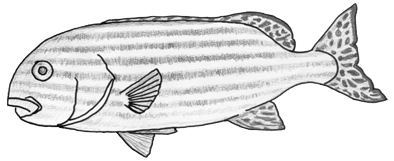
Motawurwur pilage
poisson récifal, jaune à bandes horizontales
Fish
1 – Oriental sweetlips, bsl. Yelo tiklips: reef fish, 50 cmwan fish, Yelo tiklipsDiagramme-à-bandes-horizontales (angl. Oriental sweetlips), poisson récifal, 50 cmPlectorhynchus orientalis.
seenē-mlag